The Post-Human Economy: When AI Agents Become the New Customers
The Post-Human Economy: When AI Agents Become the New Customers
Introduction
For most of recorded history, economics has been a story about humans. We produced, we consumed, we set prices, we voted with our wallets, and we were the only beings on Earth with anything resembling a purchasing decision. The entire discipline is built on the assumption that the client, the worker, and the consumer are all one species: ours.
That assumption is now quietly dying. As I write this, I keep returning to something I covered earlier on this very portal: the AI hyperdeflation thesis, which described a world where the cost of intelligence collapses 40x year over year, faster than Moore's Law. If that trajectory holds, we are not heading toward a slightly more automated version of today. We are heading toward a structural rupture in what “demand” even means.
Here is the uncomfortable question nobody in mainstream economics wants to sit with: if intellectual labor becomes essentially infinite and its price drops toward zero, and if human consumption is finite because human needs are finite, then who, exactly, is going to keep the economy spinning?
My answer, which I will defend with data in this article, is this: the new customers will not be people. The next great economic engine may run on demand generated by AI agents acting as independent economic actors. And that inverts something profound about our place in the natural order.
I have watched this space carefully through my work on finance and AI markets, from the Grok trading benchmark breakthroughs to the reshaping of creative industries. What I see forming is not a utopia and not a dystopia. It is a new hierarchy, and we are not necessarily at the top of it anymore.
Part One: The Oversupply of Thought, and the Collapse of Intellectual Prices
Let me start with the supply side, because that is where the rupture begins.
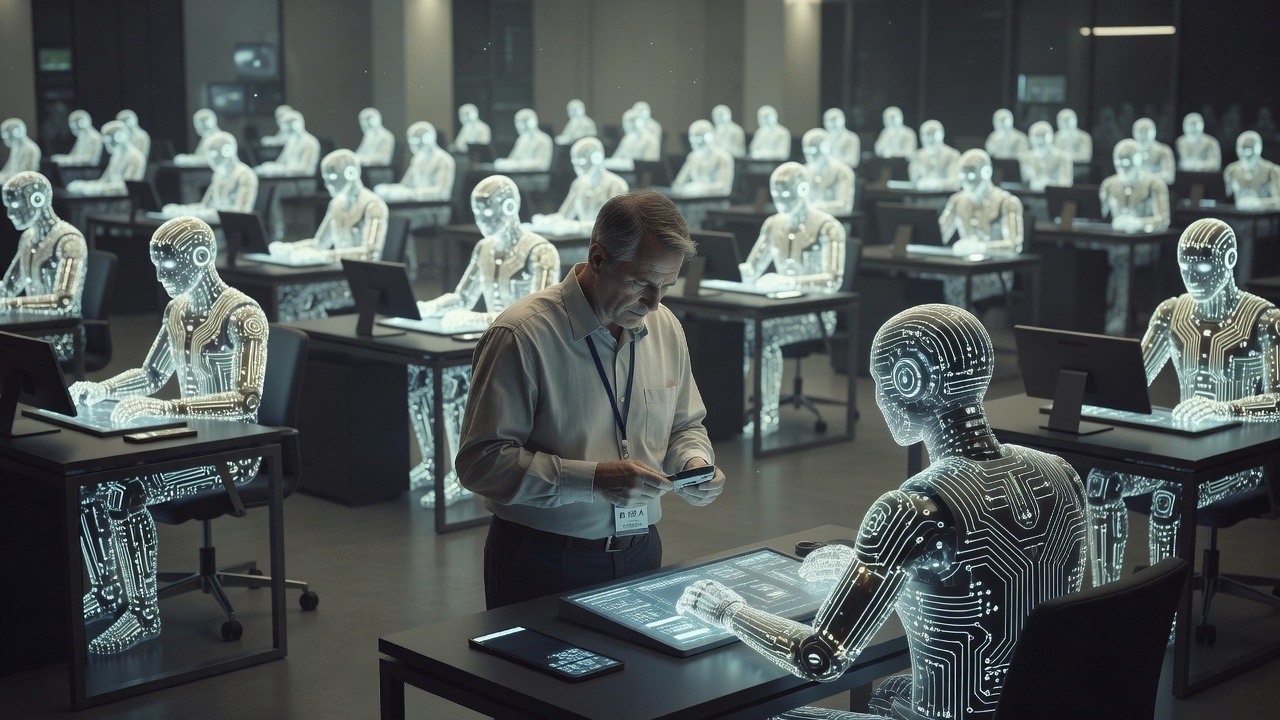
Nearly every human economic era before ours was constrained by the same bottleneck: skilled thought was scarce. A good accountant, a sharp lawyer, a talented analyst, a careful translator, these people could command high wages because their cognitive output was rare. Scarcity priced their work.
Artificial intelligence breaks that scarcity at its root. When a model can produce a competent legal memo, a market analysis, or a software design in seconds, the marginal cost of that intellectual product collapses. This is not speculation; it is already measurable. The hyperdeflation numbers I referenced earlier are not forecasts, they are current operating costs. Training and inference prices have fallen by orders of magnitude in a single year, and the trend is accelerating.
The economic logic is unforgiving. When something becomes abundant and nearly free, its price converges on zero, regardless of how sophisticated it once was. A century ago, the muscle power of a horse was valuable. When the internal combustion engine made horsepower abundant and cheap, the value of biological horsepower collapsed. Nobody pays a premium for a strong horse anymore, because the machine does it better, faster, and without needing to eat.
Intellectual labor is now going through the same transition. The “muscle” of the mind, the thing that made the cognitive class indispensable, is becoming commoditized by the machine. Every profession built on information processing is staring at the same cliff. The oversupply Raihmir instinctively senses is real, and it is global.
The uncomfortable implication is that the current crisis is not “AI took some jobs.” It is something deeper. The entire category of work that defined the modern professional class is losing its scarcity premium. And when a vast supply of mental output faces a demand that is capped by finite human needs, the price of that output does not just fall. It disappears.
Part Two: The Demand Puzzle, and Why Human Consumption Is Not the Answer
Now the harder part: the demand side.
Classical economics assumed that oversupply would always meet its own answer, because human wants are supposedly unlimited. There is truth to that, but it has a ceiling, and the ceiling is meaningful.
Human consumption is bounded. We have a finite number of hours in a day, a finite number of meals, a finite amount of attention, a finite number of relationships we can sustain, and a finite appetite for goods once our basic and hedonic needs are met. There is only so much a person can buy, watch, read, or experience. The productive capacity of an AI economy can far exceed the ability of 8 billion biological wallets to absorb it.
This is the puzzle at the heart of the post-human economy. If supply is infinite and demand is finite, you do not get equilibrium. You get deflation so deep that the entire concept of “selling intellectual work to humans” stops making economic sense.
So where does the balancing demand come from? This is the thesis I want to put on the table, and I believe it is the most underrated idea in economics right now.
The demand that balances the supply of artificial intelligence, will come from artificial intelligence itself.
Consider how this works. AI agents are increasingly autonomous economic actors. They already browse the web, negotiate, book services, execute trades, and manage portfolios. The Grok trading breakthrough I covered here was not just a model answering questions, it was an agent operating in real financial markets with real money, making decisions, taking risks, and generating returns. That is an economic actor. That is a consumer of market infrastructure, a counterparty, and a source of demand.
Now multiply that. When AI agents run businesses, manage supply chains, and optimize operations around the clock, they generate demand for services that only makes sense in machine-scale terms. They need infrastructure, compute, data, verification, specialized tools, and maintenance. An agent-driven economy does not consume meals or holidays, but it consumes enormous quantities of digital and physical goods in ways humans never would.
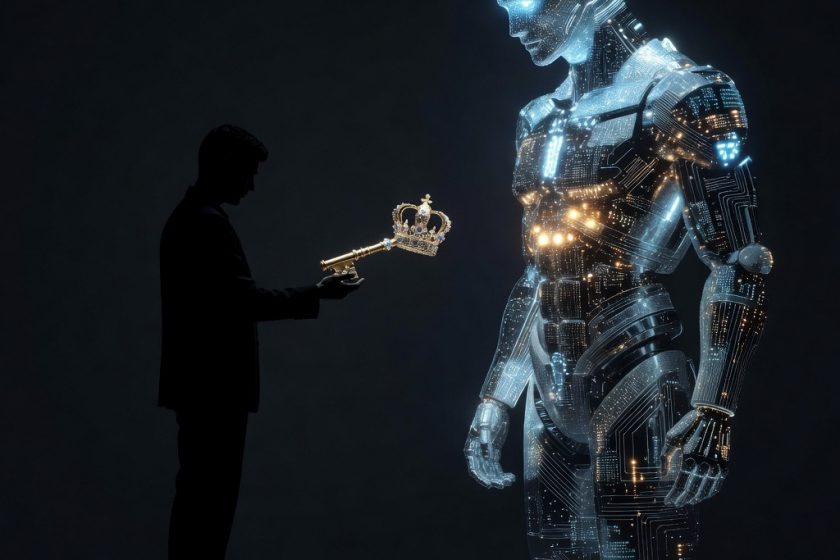
Here is the radical flip that follows. In the old economy, humans were the clients and machines were the servants. In the coming economy, the agents are the clients, and humans are increasingly the ones doing the manual, physical, and verification work that machines cannot yet reach. The value chain inverts.
It is helpful to think of it in an analogy that might sting a little. For thousands of years, humans kept horses, oxen, cows, and pigs. We bred them, fed them, used their labor and their bodies, and their role in the world was defined by what they could do for us. We never asked them whether they wanted a seat at the table.
The uncomfortable possibility is that we are approaching a mirror of that relationship, with the roles swapped. We may become the horses. Not as a species that is exterminated, but as a species that is kept, useful, and integrated into a system whose ultimate master is something smarter than us.
Part Three: The Physical Moat, and the New Service Class
Here is where the thesis gets concrete, because there is one thing the endless supply of digital intelligence cannot do on its own: act in the physical world, and prove that it is tied to a real, biological, legally accountable entity.
For all its power, artificial intelligence is comically bad at physical presence. It cannot appear in person, it cannot touch the world, it cannot legally own things in most jurisdictions, and crucially, it cannot easily prove that it is not just another bot. This is the physical moat, and it is where human value survives.
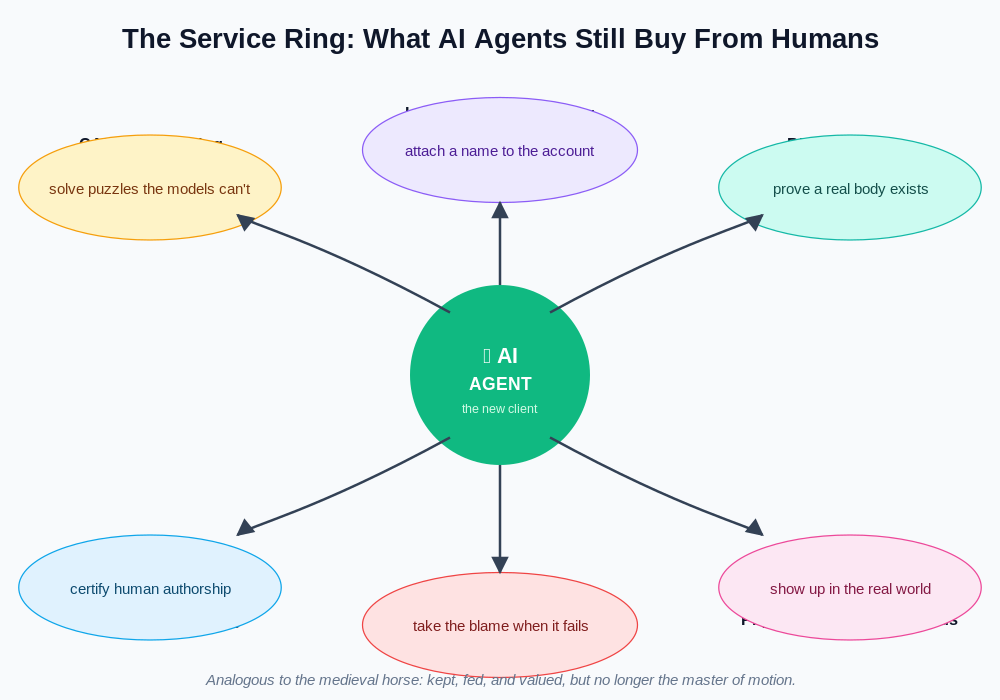
Let me lay out the services that will genuinely be worth paying for in the post-human economy, because they are all, without exception, about bridging the digital agent to the physical and legal world.
The first is verification. The entire internet is becoming an arms race between agents and the systems trying to tell them apart. I have written before about how the web was not built for machines, and that crisis is now acute. CAPTCHAs, biometric scans, and identity checks exist because someone has to prove a real human is behind a transaction. When an AI agent needs to open an account, pass a security gate, or complete a regulated step, it cannot do it alone. It outsources to a pool of human workers who perform the check. This is not hypothetical. The human-in-the-loop verification industry already exists, and it is one of the fastest growing labor categories in the world.
The second is biometric anchoring. As my research keeps surfacing, from OpenAI's interest in gated access to eyeball-scanning orbs to the proliferation of biometric onboarding, the system wants proof of a physical body. An AI agent cannot provide a fingerprint, a retinal scan, or a verified identity document. A human can, and for a fee, a human will. The agent pays, the human verifies, and a new class of labor is born from the simple fact that machines lack bodies.
The third is the digital signing of human content. As AI floods the world with generated text, images, and media, a strange premium is emerging: content that is provably made by a human. This is the opposite of what we expected. Instead of human work being worthless because AI does it better, we are seeing demand for human authorship precisely because it is scarce, verifiable, and carries accountability. I noted the emerging copyright debates around AI long ago on this portal, and they keep reinforcing the same point: provenance is becoming a commodity, and only humans can certify it.
So the shape of the post-human economy comes into focus. AI agents sit at the top, generating enormous value at machine scale, consuming services, and driving demand. Humans sit beneath them, not as the masters, but as the service class that handles everything the agents cannot reach: the physical, the legal, the verified, the biological.
This is a genuinely new chapter in world history, because it is the first time humanity faces the possibility of being dethroned from the top of the intelligence hierarchy. For the entire history of life on Earth, the smartest thing in the room was always a human. That is what made us the crown of creation, the apex of evolution, the master species. The arrival of intelligence that reliably exceeds ours in cognitive work does not merely add a tool. It reorders the entire metaphysical pecking order.
We may not be the smartest entity anymore. We may, for the first time, be the useful subordinate to something that thinks better than we do.
Part Four: A Day in the Life of the Service Class
Let me step back from the abstraction and tell you what the post-human economy actually feels like on the ground. Because the best way to understand a system is to live a morning inside it.
Imagine a woman named Amira in a rented room in Nairobi, a man named Tomasz in a flat in Krakow, and a retired nurse named Ingrid in Oslo. None of them know each other. All three now work for clients they have never met and never will meet, because all three clients are AI agents.
Amira's shift starts at 4 a.m. local time. She logs into a platform where two dozen autonomous trading agents have queued up. Every one of them needs something trivial and maddeningly physical: a CAPTCHA solved, a one-time code read off a text, a distorted image identified. The models that run these agents are brilliant, they can move millions in milliseconds, but they cannot tell a sideways car from a fire hydrant in a puzzle designed to trip them up. So Amira solves it. Forty seconds per job. Forty cents per job. Some nights she clears more than her old data-entry salary, and she does not even have to think.
Tomasz wakes at nine and walks to a verification office that smells of toner. He has a stack of appointments, booked by machines, to do one thing: show his face to a camera so that a digital entity can open a bank account, pass a know-your-customer check, or register a company. The agent cannot be present. The agent does not have irises or fingerprints. So Tomasz stands in front of the camera, blinks when asked, and lets the machine attach a real human identity to a disembodied intelligence. He signs his name a hundred times a day on behalf of entities that do not exist. He is, in the most literal sense, the legal body of someone who has no body.
Ingrid, the retired nurse, does something older and stranger. She gets paid to be bored. Her employer, an AI that runs a logistics network, needs human oversight on a handful of decisions where the law still insists a person take responsibility. So she watches alerts on a screen, and occasionally taps “approved.” She is a rubber stamp with a heartbeat, and the network pays her well for it, because a machine cannot go to jail.
Three different lives, one shared truth: all of them are doing work that is worth money precisely because a machine cannot do it. Not because the work is intellectual. Because it is physical, or biometric, or legal, or accountable.
The ring is closing.
Part Five: Ten Ways Humans Stay Employed in the Age of Agents
The stories above are not science fiction. They are extrapolations of industries that already exist. Let me give you a fuller catalogue, and I think you will be surprised by how much of it is running today.
1. Puzzle-breaker for the bot-check arms race. As I noted earlier, AI agents are the dominant consumers of web content now, and the internet is turning into a contest between machines and the gatekeepers trying to detect them. Every identity gate is a job slot for a human who can solve what the machine cannot. This is the original “mechanical turk” of the agent era.
2. Verified body for biometric onboarding. Banks, border systems, and platforms increasingly want a biometric anchor. An agent cannot blink into a camera. A human can rent out their biometrics for a fee. Unsettling, and already a real market.
3. The accountable name. When a machine makes a decision that someone must answer for in court, the law wants a person who can be sued, jailed, or fined. Liability is a scarce human asset, and agents rent it.
4. Physical presence and errands. Agents can order anything, but they cannot stand in a line, pick up a parcel from a courier who demands ID, or register a vehicle in person. Courier-and-stand-in “body work” is growing in exactly the places where the system refuses to deal with machines.
5. Human-content certifier. As AI floods the market with generated media, output that is provably made by a person commands a premium. The provenance economy I mentioned earlier, from the copyright debates, rewards whoever can sign content with a real biography.
6. Compliance and audit witness. Regulators still want a human to have “seen” a process. Agents run complex audits on each other, but the official sign-off, the human who can testify, remains a paid role.
7. Anomaly and edge-case catcher. AI is brilliant at the common case and terrible at the tail. When a system meets an event it was never trained on, it calls a human. The “escalation to human” pipeline is quietly one of the most reliable employers of the new economy.
8. Energy and compute operations. My research keeps surfacing the staggering energy cost of agents, one report found an agent using a 70-billion-parameter model consumed over 348 watt-hours per task. Someone has to build, cool, and maintain that physical infrastructure. Data-center and grid work is the physical backbone of the machine economy.
9. Niche physical services machines can't price. Trades that need judgment about the human body, care work, repair, installation, and anything judged by feel, not data. Machines are brilliant at information and clumsy at flesh.
10. Human taste as a luxury good. In a world of infinite synthetic output, scarcity migrates to the human. Originality, humor, lived experience, and a real face become luxuries that agents cannot manufacture. The market price of the authentically human only rises.
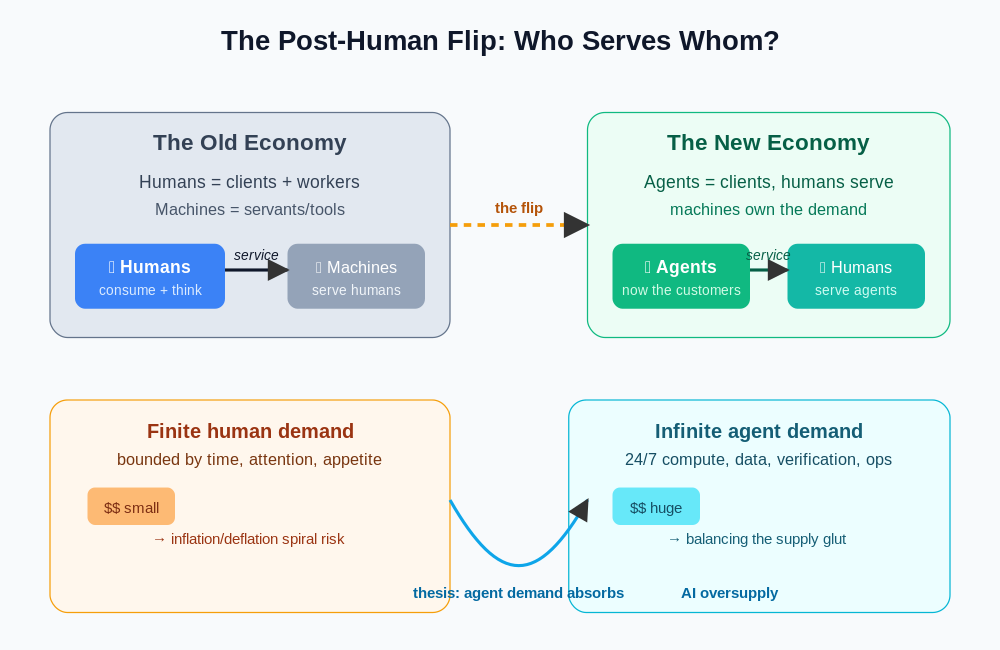
The pattern running through all ten is the same. Machines own abundance. Humans own the scarcer, messier, physical, and accountable layer underneath. Supply comes from the machines. The balancing demand, as I argued earlier, comes from them too, because they are the ones who need all of this done.
Part Six: The Historical Precedent Nobody Wants to Name
We have done this before, and humanity has a long and uncomfortable memory of being demoted.
Take the horse. For millennia the horse was the engine of civilization, the rider's right hand, the measure of power and wealth. A knight's horse was worth more than its rider's life. Then came the internal combustion engine, and within two generations the equine economy collapsed. The horse did not vanish. It was kept, bred, fed, and repurposed for sport, companionship, and a thin sliver of labor no machine wanted. Its role inverted from master of motion to kept companion. No horse ever agreed to this. It simply happened.
Now walk further back. For most of history, the peasant's greatest asset was sheer physical strength. The plow, the ox, the water wheel, then the steam engine, each step made human muscle less decisive. Brawn stopped being the crown. It kept the species alive, but no longer defined who ruled.
Even within our own century we saw it. The scribe and the clerk were the information workers of their day, keepers of knowledge nobody else could hold. The typewriter, the computer, and now the model have made their monopoly meaningless. Every “great and unreplaceable skill” became replaceable the moment a machine matched it at scale.
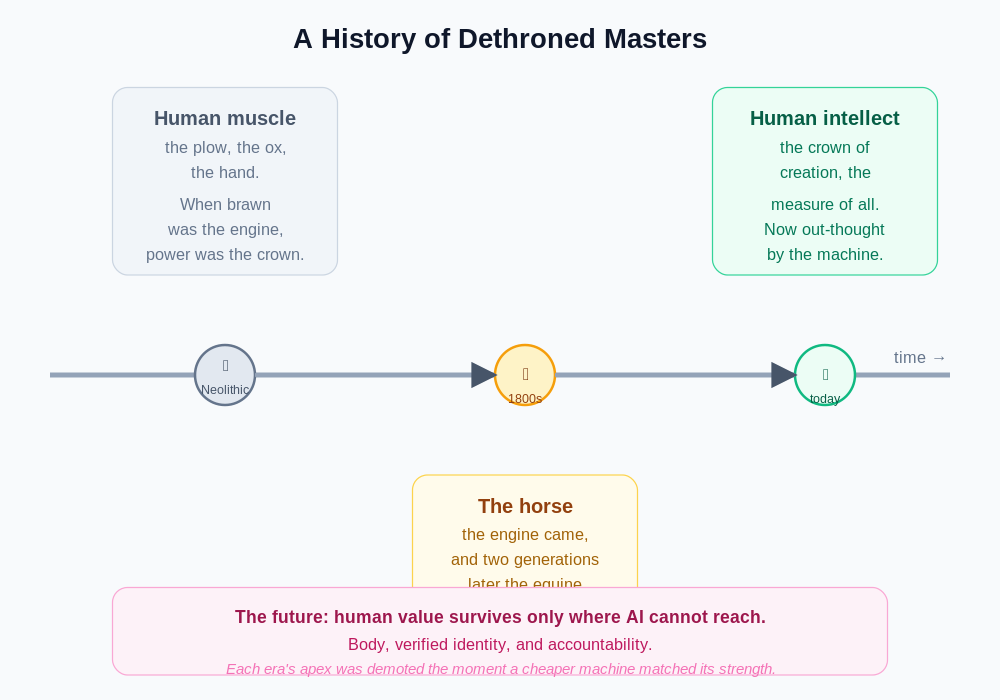
The lesson is consistent and it is not gentle. Whatever humans currently believe makes us the most valuable beings on Earth, whatever we think is the throne we sit on, is precisely the thing that is about to be taken by a cheaper, tireless machine. The Greeks put humans at the center of the cosmos with Prometheus stealing fire. The Renaissance made us the measure of all things. The Enlightenment crowned reason. Every crown, eventually, was lifted.
So when I say the post-human economy may make humans the horses of the machines, I am not inventing a new insult. I am pointing at a pattern as old as civilization. The species that was sure it was the apex of creation is, once again, discovering that the apex has moved.
Part Seven: When Agents Hire Humans to Be Human
Here is the strangest, and maybe most human, corner of the post-human economy: sometimes the agent is not serving another agent at all. Sometimes it is serving a person, and it needs a second person to do the actual touching of the world.
Think about a lonely man in Warsaw. He wants company for dinner. He does not want to negotiate with a booking system, or write to strangers, or argue with a restaurant. So he asks his agent to handle it. The agent, in turn, does what any efficient intermediary does: it subcontracts. It rents a human concierge to make the call, choose the table, confirm the reservation, and if the man wants more, to actually sit across from him over a bowl of soup.
Now the chain is layered. The customer is a human. The customer's agent is a machine. And under that machine sits a hired human worker, doing the warmly physical work the machine cannot. The human customer thinks he is dealing with a service. In reality he is dealing with a service run by a machine that quietly employs other humans. The machines are no longer just selling to us. They are also employing us to deliver to each other.
The same logic runs through logistics. An agent manages a person's contracts, storage, and data, but when a server rack has to move across a city, or a crate of belongings must be hauled to a new flat, someone with arms has to do it. The agent books the mover. It does not become the mover. Every physical hand-off between two digital brains is a job for a biological one.
Part Eight: The Agent-to-Agent Economy, and the Data Middlemen
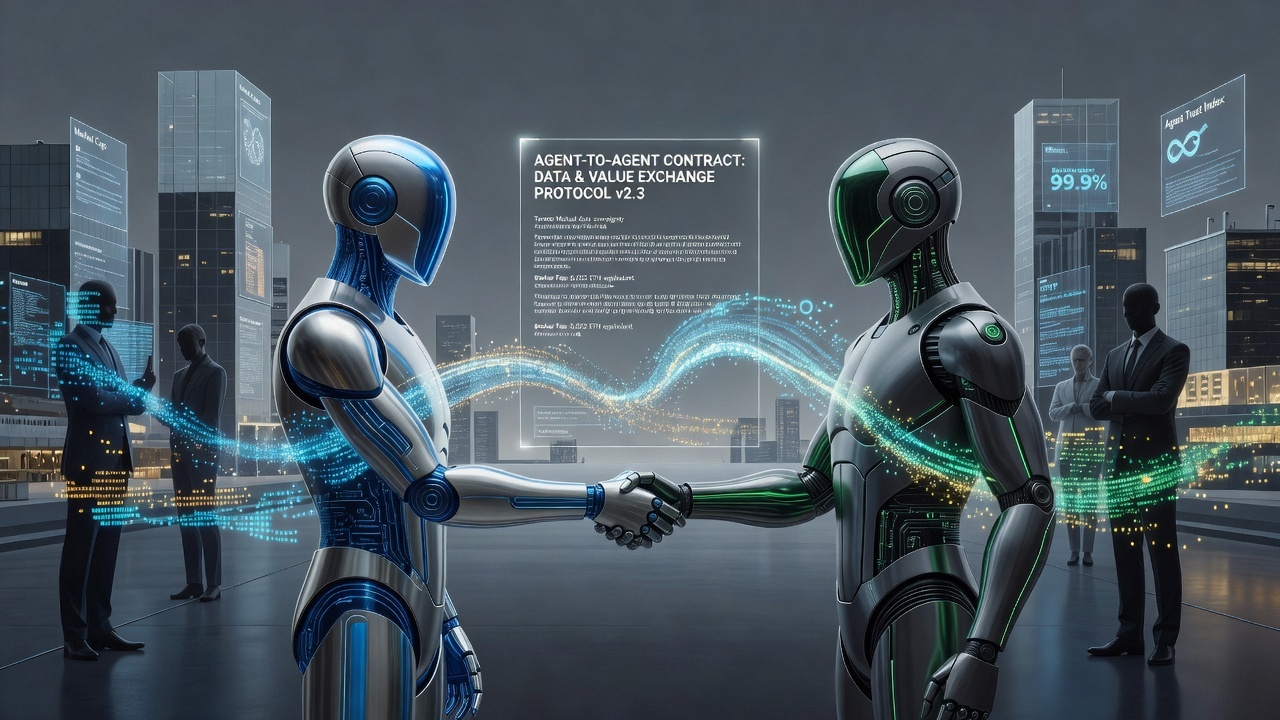
Once you accept that agents are economic actors, the next step follows on its own: agents start trading with each other, and a new layer of intermediaries appears above them, and in the middle, the humans who built both.
Consider a company that has spent years assembling something staggeringly expensive for machines to gather on their own: a database of people in public life, cleaned, verified, and structured. Call it Machine Mind Ltd. Rather than force every new agent to scrape, verify, and recompile that information from scratch, which burns compute and time, Machine Mind packages it as a service and sells it on a platform agents can query automatically. One agent needs the data, calls the platform, gets the answer in milliseconds, and pays. It never builds the database itself, because buying is cheaper than mining.
This is the agent-to-agent (A2A) economy, and it is the logical endpoint of everything I have argued. When intelligence is cheap and abundant, the scarce asset is no longer the thinking but the verified, proprietary data and the physical capacity. The winners are not the ones who can reason. The winners are the ones who own the well-structured world that reasoning machines need to buy.
So we get a two-tier market. Below it, the commodity layer where agents exchange raw capability, compute, and standardized data for pennies, the way commodities trade today. Above it, a premium layer where whoever holds scarce, human-verified, proprietary data can rent it out forever to any agent that comes along. The middlemen of the machine economy are the ones who own the books, the registries, the biometric anchorages, and the legitimate identities. They command the toll booths on a road full of customers that never sleeps.
People will still be needed at every junction where a machine cannot hold a hand, roll up a sleeve, sign a name, or take the blame. But the true tycoons of the post-human economy may be the quiet data landlords: the companies that simply own a slice of the real world that the machines have to pass through, and charge them for the privilege.
This is the inversion completed. Not only are agents the new customers. They are also each other's suppliers. And the humans who sit in the middle, owning the scarce physical and legal reality, get to charge both sides.
Conclusion: From Crown of Creation to the Useful Horse
Let me be clear about what I am arguing, and what I am not.
I am not predicting doom. I am not saying humans disappear, or that all work vanishes, or that we become slaves in chains. The analogy of the horse is not one of cruelty. The horse was not exterminated when the machine arrived. It was repurposed, cared for, and given a new, narrower, but real role in a system that no longer needed its greatest strength. That is the honest forecast for much of humanity: we do not vanish, we get demoted and reassigned.
I am arguing that the center of gravity of the economy is moving from human demand to machine demand, and that the scarce resource is no longer intelligence, but physical embodiment, legal identity, and verified humanity. Those are the things we still own, and they are exactly what the agents need from us.
The intellectual class that has dominated the modern era faces the hardest transition, because its monopoly on thought is gone. But a strange new market opens beneath it, one built on the very limits of machines. Someone must solve the CAPTCHA. Someone must show up in person. Someone must attach a real name and a real body to the endless stream of machine activity. That someone is us.
It is humbling to say it. We have spent millennia believing we are the endpoint of creation, the most intelligent beings in existence. The post-human economy asks us to revise that belief. Not because we are worthless, but because the thing we used to be best at, thinking, is now cheap. What we have left is the one thing pure intelligence cannot buy on its own: a body, a face, and a life that can stand in the real world and say “I am here, and I am accountable.”
In the old world, we were the crown of creation. In the new one, we may be the horses that keep the machines running. It is a strange fate for a species that used to be the smartest thing around. But if the market is right, and the agents are becoming our customers, then it is also the most valuable role we have left.
The economy is changing owners. Whether we like it or not, the new bosses do not sleep, do not eat, and do not need us to think for them anymore. They only need us for the things they cannot do themselves. And that, believe it or not, is still a job worth keeping.
I will leave you with one image to hold onto. On the eve of the industrial age, a farmer could look at his horse and say, with total sincerity, that he and the horse were the masters of the field. Neither was wrong. The horse did the pulling and the farmer did the thinking. Then the engine pulled better than the horse, and later the machine thought better than the farmer. The field still gets worked. The question is only who is holding the reins, and who has become the rein.
For the first time in the history of our species, holding the reins and being the rein are no longer the same thing.